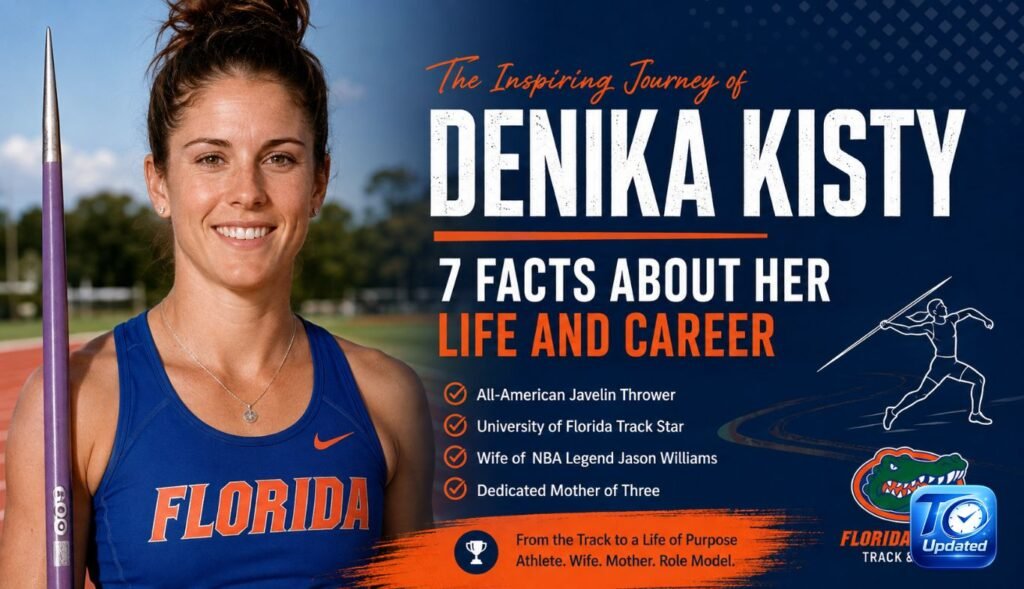
Denika Kisty
Denika Kisty is a name that often appears in searches about former NBA point guard Jason Williams. Yet describing her only as the wife of the basketball star leaves out an important part of her story. Before her connection to professional basketball became part of her public profile, she had already established herself as a highly accomplished track and field athlete.
Her specialty was the javelin throw, a demanding event that combines speed, strength, coordination, timing, and technical precision. During her high school years in Pennsylvania, she developed into a standout competitor. Later, she continued that journey at the University of Florida as a member of the Florida Gators track and field program.
Florida’s official track and field record book lists Kisty among the program’s women’s outdoor All-Americans. The university’s records currently credit her with one outdoor All-American honor.
That athletic background makes Denika Kisty particularly interesting to sports fans. Her story is not simply about being connected to an NBA player. Instead, it is about a former elite college athlete whose own competitive career preceded the public attention surrounding her family.
At the same time, there is a reason some details about her life remain difficult to verify. She has maintained a relatively private public profile, and many websites repeat information that cannot be traced to strong primary sources. Consequently, a responsible biography should separate documented achievements from estimates and online speculation.
This guide examines Denika Kisty through that lens. It covers her athletic background, education, Florida years, connection to Jason Williams, family life, public profile, and the facts that can and cannot be confidently established.
Who Is Denika Kisty?
Denika Kisty is a former American track and field athlete whose best-known event was the javelin throw. She competed at the University of Florida and earned All-American recognition during her collegiate career.
Her name became more familiar to a broader sports audience through her marriage to Jason Williams, the former NBA guard popularly known as “White Chocolate.” Williams became famous for his creative passing, quick ball handling, and entertaining style during his NBA career.
However, the athletic connection between the two goes deeper than basketball. Kisty was herself a college athlete competing at a high level. That shared understanding of training, competition, pressure, and performance likely provides useful context for understanding their relationship, although specific private details about how their relationship developed should not be treated as established fact without direct sourcing.
A University of Florida yearbook from 1998 provides particularly useful evidence. It identifies Kisty as a member of the 1997–98 Florida women’s track team. The yearbook also places her alongside other members of the program during that period.
That primary-source evidence is more valuable than the many unsourced celebrity biographies circulating online.
Denika Kisty’s Early Athletic Background
The publicly available record of Denika Kisty becomes clearer when her athletic career is examined rather than her private life.
Athletic records identify her with Brentwood High School in Pennsylvania. Athletic.net lists competition results from the early and mid-1990s, including javelin performances and a 100-meter hurdles result. Her javelin mark reached 151 feet in 1995 according to the site’s historical record.
These records illustrate something important: her athletic ability was not a late development.
She was already competing seriously while still in high school. Javelin is especially demanding because success requires more than raw strength. Competitors need an efficient approach run, controlled footwork, upper-body power, release timing, balance, and an understanding of how the implement responds to technique.
High School Track and Field
Several biographical sources report that Kisty won major high school javelin honors in Western Pennsylvania during the 1994 and 1995 seasons. Those reports should be read alongside available athletic records rather than accepted blindly.
The strongest takeaway is that she was a competitive high school thrower who progressed to the collegiate level.
Her 1995 Athletic.net record is particularly useful because it records a 151-foot javelin performance for Brentwood and identifies it as a personal best and school record in the historical listing.
That type of record provides a much stronger foundation for her biography than unsupported claims about her childhood, personality, or family circumstances.
Denika Kisty at the University of Florida
College represented the most important stage of Denika Kisty’s athletic development.
She joined the University of Florida’s track and field program during the 1990s, competing as a javelin thrower. The Florida Gators program has a long history of producing elite track and field athletes, and making the roster itself represented a significant competitive achievement.
The 1998 University of Florida yearbook confirms Kisty’s place on the women’s track team during the 1997–98 season. It lists her among the athletes in the program and shows that she was part of a team that competed at the highest levels of collegiate track and field.
Florida’s official historical record provides even stronger evidence of her collegiate standing. The university’s current track and field record book lists Kisty among the school’s women’s outdoor All-Americans, with one All-American honor.
For readers unfamiliar with college sports, All-American recognition is significant. It indicates that an athlete reached a level of performance worthy of national recognition within collegiate competition.
Why Her All-American Status Matters
The phrase “All-American” is sometimes used casually on entertainment websites. In college athletics, however, it carries real significance.
Kisty competed in a technical field event against athletes from universities throughout the country. Her recognition therefore reflects performance in a highly competitive environment.
This is one of the most important verified facts about her career.
It also changes how her story should be framed. Rather than presenting her simply as a celebrity spouse, it is more accurate to describe her as a former high-level collegiate athlete who later became known more broadly through her family connection to professional basketball.
Javelin Throw: The Sport Behind Her Career
Understanding the javelin helps explain why the athletic record of Denika Kisty deserves attention.
Javelin is a field event in which competitors run along a runway before throwing a spear-like implement for distance. The goal sounds simple, but elite performance depends on a carefully coordinated sequence.
The athlete accelerates during the approach, transitions into the throwing phase, creates a powerful transfer of energy through the body, and releases the javelin at a precise moment.
Small technical differences can have a major effect on distance.
A successful thrower therefore needs explosive strength as well as body control. Speed matters because the approach creates momentum. Flexibility matters because the body must move through a large range of motion. Timing matters because a powerful throw can still fail if the release is poorly executed.
Kisty’s record shows that she developed those abilities at a high level.
Her high school performances and later All-American recognition at Florida demonstrate a progression from promising young competitor to nationally recognized collegiate athlete.
Denika Kisty and Jason Williams
For many people, the first reason they encounter Denika Kisty is Jason Williams.
Williams enjoyed a memorable NBA career after becoming a standout at the University of Florida. He played for several NBA teams and became particularly associated with creative passing and an improvisational style of play.
His nickname, “White Chocolate,” became widely recognized among basketball fans.
Kisty and Williams also shared the experience of competing as student-athletes at Florida. Multiple biographical sources identify the University of Florida as the setting where their paths crossed.
However, the exact details of their early relationship are not documented extensively in primary public sources. Therefore, claims about precisely when they met or how their relationship developed should be presented as reported information rather than absolute fact.
What is well established is that they later married and built a family together.
Marriage and Public Attention
Public biographies generally place their marriage in 2003. However, the exact wedding date is repeated inconsistently across online sources.
That distinction matters because celebrity biographies frequently copy information from one another. Once an unsupported date appears on several websites, repetition can make it look authoritative even when no primary source confirms it.
For that reason, the safest description is that Kisty and Williams married in the early 2000s, with multiple biographies reporting 2003.
Their relationship also illustrates an unusual meeting point between two sports worlds: college track and field and professional basketball.
While Williams eventually became internationally known through the NBA, Kisty’s own athletic identity had already been established.
Family Life
Family is another major part of Denika Kisty’s public story.
Kisty and Jason Williams have three children, according to multiple published profiles. Their daughter Mia Williams has received considerable attention because of her own career in college softball.
Mia’s athletic path is especially relevant because it demonstrates how sporting talent and competitive culture continued into the next generation.
A 2024 report from The U.S. Sun described Mia as a Florida Gators softball player and identified Kisty as a former two-time All-American on Florida’s track and field team. The article also discussed the family’s competitive environment and Mia’s development as a softball player.
That reporting offers a useful glimpse into the family’s athletic background without requiring speculation about their private household.
Mia Williams and the Family’s Athletic Legacy
Mia’s career has helped bring renewed public attention to Denika Kisty.
Instead of being known only through her husband’s basketball career, Kisty increasingly appears in stories about a family with multiple generations of athletes.
Mia pursued softball rather than simply following her father’s basketball path. That choice is significant because it shows that athletic families do not necessarily produce identical careers.
According to The U.S. Sun’s reporting, Mia developed into a highly regarded softball prospect and eventually played for the Florida Gators.
Kisty’s own background in track and field provides a natural connection to the demands of competitive sport. Still, it would be inaccurate to assume that every achievement by her children resulted directly from her athletic career. Their individual work, coaching, talent, and choices matter too.
Denika Kisty’s Approach to Privacy
One of the defining characteristics of Denika Kisty is her limited public presence.
Unlike many people connected to professional athletes, she has not built a major public brand around her relationship with Jason Williams. There is limited reliable information about her day-to-day activities, professional work, personal finances, or private interests.
That lack of information should not automatically be interpreted as evidence that she has no professional or community activities. It simply means that reliable public documentation is limited.
This is an important distinction in the age of social media.
People often assume that a person connected to a famous athlete must have a large online footprint. Kisty’s case demonstrates the opposite. A person can remain connected to sports history while maintaining considerable personal privacy.
For journalists and readers, that means restraint is important.
A biography should focus on what can actually be documented instead of filling gaps with assumptions.
What Is Known About Her Age?
Searches for Denika Kisty often produce different birth years and exact birthdays.
Some websites list 1977, while others provide different dates. Because there is no strong primary source establishing an exact birth date in the material reviewed for this article, a precise age should not be presented as confirmed.
This is one of the areas where readers should be careful.
Celebrity biography websites frequently publish exact dates without identifying where the information came from. Other sites then repeat those details. Over time, the claim can appear established even though it originated from an unknown source.
A more responsible approach is to state that public profiles commonly place her birth in the late 1970s while acknowledging that the precise date is not firmly verified.
Denika Kisty’s Net Worth: What Can Be Verified?
Financial claims about Denika Kisty require even more caution.
Various websites publish estimated net-worth figures ranging from hundreds of thousands of dollars to more than $1 million. Those estimates are not supported by a publicly available financial statement, audited record, or reliable disclosure from Kisty herself.
Therefore, an exact net worth should not be presented as fact.
Her husband’s professional basketball career is a separate financial matter. Jason Williams earned income through his NBA career and other activities, but his finances should not automatically be attributed to Kisty personally.
This distinction is particularly important in celebrity SEO content.
A website may gain clicks by publishing a large estimated net worth, but an unsupported number does not become factual merely because it appears in multiple search results.
For Denika Kisty, the more useful story is her documented athletic career rather than an unverifiable financial estimate.
Her Athletic Legacy
The athletic legacy of Denika Kisty is arguably the most overlooked part of her biography.
Her journey moved through several stages:
- High school track and field competition in Pennsylvania.
- Development as a javelin specialist.
- Collegiate competition at the University of Florida.
- All-American recognition.
- A later life associated publicly with an NBA family.
That progression tells a more interesting story than a simple celebrity-spouse biography.
It also provides an example of how women’s collegiate athletics can remain overlooked when an athlete later becomes connected to a more famous sports figure.
Jason Williams’ basketball career naturally attracted more media attention. The NBA has enormous visibility, while college track and field receives considerably less mainstream coverage.
As a result, many people discovering Kisty today may encounter her name through her husband’s biography before learning about her own athletic achievements.
The historical record reverses that order.
Before she was known primarily as Jason Williams’ wife, she was a competitor.
Why Denika Kisty Still Attracts Interest
Interest in Denika Kisty comes from several overlapping areas.
First, basketball fans remain interested in Jason Williams and the people closest to his career.
Second, sports fans are curious about her own accomplishments at Florida.
Third, the athletic careers of her children, particularly Mia Williams, have introduced a new generation of attention to the family.
Finally, her relatively private lifestyle creates curiosity.
In modern celebrity culture, public figures often share personal information constantly. Kisty’s limited public presence creates a different kind of profile. Readers have to rely on historical records, sports archives, reputable reporting, and carefully sourced biographies.
That makes source quality particularly important.
What Reliable Sources Tell Us
When researching Denika Kisty, readers should prioritize primary or authoritative sources whenever possible.
The University of Florida’s official track and field record book is especially valuable because it directly documents her All-American recognition.
The university’s historical yearbook also provides evidence that she was part of the 1997–98 women’s track team.
Historical athletic databases can add useful competition results. Athletic.net, for example, records her Brentwood High School javelin performances from the 1990s.
Meanwhile, established sports reporting can provide context about her family and daughter Mia’s softball career.
Together, these sources provide a stronger foundation than anonymous celebrity blogs.
Denika Kisty and the Importance of Source Checking
The online biography of Denika Kisty demonstrates why source checking matters.
Some claims about her birth date, height, net worth, parents, residence, social media accounts, and career after college appear repeatedly online. Yet repetition does not equal verification.
For example, a website might state an exact birthday without providing a source. Another website may copy the same date. A third website may then cite the second website. Search engines can eventually display all three pages, giving the impression that three independent sources agree.
In reality, they may all originate from one unverified claim.
A better research process is to ask:
- Is the information supported by a primary source?
- Is the source identifiable?
- Do reputable publications agree?
- Does an official sports record confirm the athletic claim?
- Is the information current?
- Does the claim distinguish fact from estimate?
Using those questions produces a much more reliable biography.
A Look at Her Broader Sports Legacy
The story of Denika Kisty also fits into a larger conversation about former college athletes.
College sports can shape an individual’s identity long after competition ends. Training teaches athletes how to manage schedules, recover from setbacks, work toward measurable goals, and perform under pressure.
Those skills do not disappear when an athlete stops competing.
In Kisty’s case, her athletic history also became part of a family environment where competitive sports remained important.
Her daughter Mia’s softball career demonstrates that the family’s connection to athletics continued into another generation.
However, legacy should not be confused with inheritance of talent alone.
Every athlete has to develop independently.
That is one reason Kisty’s own career remains worth examining. Her All-American recognition was earned during her own years of competition.
Frequently Asked Questions
1. Who is Denika Kisty?
Denika Kisty is a former American track and field athlete who specialized in the javelin throw. She competed for the University of Florida and earned All-American recognition. She is also publicly known as the wife of former NBA guard Jason Williams.
2. What sport did Denika Kisty play?
Denika Kisty competed in track and field, with the javelin throw as her best-known event. Historical athletic records also show a 100-meter hurdles result during her high school years.
3. Did Denika Kisty attend the University of Florida?
Yes. Denika Kisty was a member of the Florida Gators women’s track and field program. A 1998 University of Florida yearbook identifies her as part of the team.
4. Was Denika Kisty an All-American athlete?
Yes. The University of Florida’s official track and field record book lists Denika Kisty among its women’s outdoor All-Americans, with one outdoor All-American honor.
5. Is Denika Kisty married to Jason Williams?
Yes. Public reporting and biographies identify Denika Kisty as the wife of former NBA player Jason Williams. Multiple sources place their marriage in 2003, although the precise wedding date is not consistently documented in strong primary sources.
6. How many children does Denika Kisty have?
Public reports identify Denika Kisty and Jason Williams as parents of three children. Their daughter Mia Williams has received substantial public attention as a college softball player.
7. What is Denika Kisty’s net worth?
There is no reliable public financial statement establishing Denika Kisty’s personal net worth. Websites publish different estimates, but those figures should be treated as speculation rather than verified financial information.
8. Why is Denika Kisty not widely covered in the media?
Denika Kisty has maintained a relatively private public profile. Most reliable information about her comes from sports records, historical documents, and reporting connected to her family rather than from frequent interviews or personal media appearances.
Conclusion
The story of Denika Kisty is more substantial than the simple label of “NBA player’s wife.”
Her athletic record provides the strongest foundation for understanding her public identity. She competed in high school track and field, developed as a javelin thrower, joined the University of Florida program, and earned All-American recognition. Florida’s own historical records confirm her place among the school’s women’s outdoor All-Americans.
Her connection to Jason Williams brought additional public attention, but it did not create her athletic identity.
The family story has also continued through the next generation, particularly through daughter Mia Williams and her softball career at Florida.
At the same time, some popular details about Kisty remain uncertain. Her exact birth date, personal net worth, and several aspects of her private life are not sufficiently documented to justify presenting online estimates as established facts.
That distinction matters.
A strong biography does not need to fill every blank. Instead, it should explain what is known, identify what remains uncertain, and rely on credible records wherever possible.
Final Thoughts
Denika Kisty offers an interesting example of a sports figure whose own achievements have sometimes been overshadowed by a famous family connection.
Her story begins on the track, not in the NBA spotlight.
The available record shows a talented javelin thrower who progressed from Pennsylvania high school competition to the University of Florida and ultimately earned All-American recognition. That achievement alone gives her a legitimate place in the history of Florida collegiate athletics.
Her later family life added another dimension to that story. Through Jason Williams and their children, particularly Mia’s softball career, her connection to competitive sports continued.
Perhaps the most notable feature of her public profile, however, is her privacy.
In an era when celebrity culture rewards constant exposure, Kisty has largely remained outside that cycle. As a result, the most meaningful way to understand her is not through rumors or unsupported net-worth figures, but through the athletic records and credible reporting that document what she actually accomplished