mathsframe
Finding effective ways to make maths more enjoyable can be challenging, particularly when children need regular practice with number skills, problem solving and mathematical reasoning. mathsframe is a search term associated with the Mathsframe website, an online learning platform built around interactive maths activities for children in the UK.
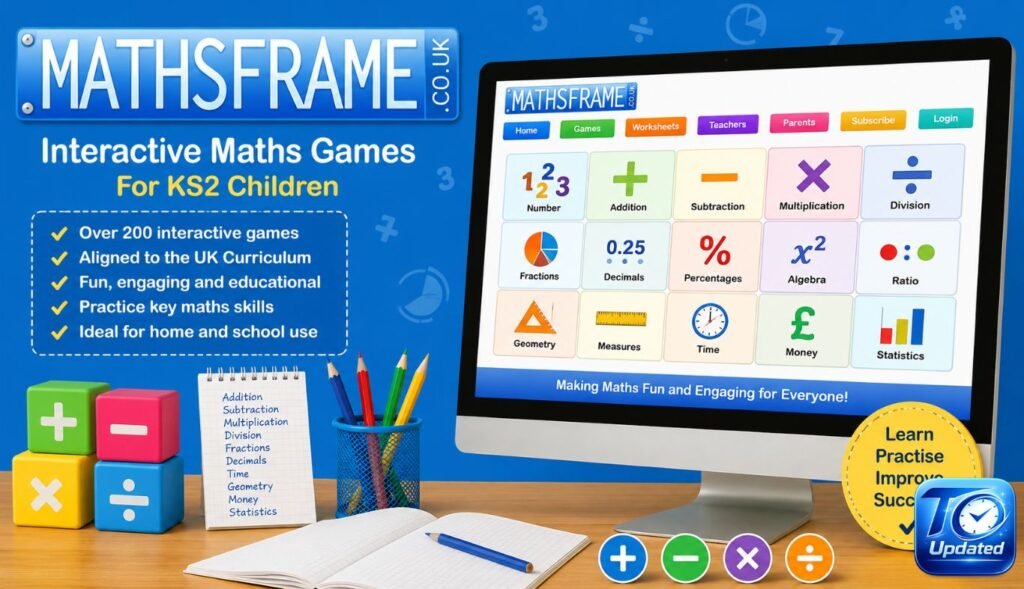
Mathsframe offers a broad collection of browser-based maths games and educational resources. Its current website describes more than 200 interactive games alongside worksheets and assessments covering areas such as addition, subtraction, multiplication, division, fractions, decimals, percentages, geometry, measurement, time, money and statistics.
For parents and teachers, the appeal is straightforward: children can practise mathematical skills through activities that feel more engaging than conventional worksheets alone. Instead of simply answering questions on paper, learners can interact with problems, receive feedback and repeat activities to strengthen fluency.
The mathsframe experience is particularly relevant to families looking for additional Key Stage 2 maths practice. It can also complement classroom teaching by giving pupils another way to revisit concepts that have already been introduced by their teacher.
However, an educational game should not replace good teaching. The strongest results usually come when interactive practice is combined with explanation, discussion, written work and opportunities to apply mathematical ideas in unfamiliar situations.
This guide explains what mathsframe means in practical terms, how Mathsframe works, which types of activities learners can find, and how parents and teachers can use online maths games effectively.
What Is mathsframe?
mathsframe refers to the Mathsframe online learning resource and the way users may search for or identify the platform. The official Mathsframe website positions itself as an interactive maths resource for children, teachers and parents.
The platform is particularly associated with primary-school mathematics and Key Stage 2 learning. Its resources cover many of the mathematical topics children encounter during their primary education.
Rather than presenting maths as one large subject, the website breaks learning into manageable areas. A child who needs multiplication practice, for example, can work on multiplication-related activities rather than navigating through unrelated material.
That organisation can make independent practice easier.
The platform also uses games as an important part of its learning approach. This matters because repetition is often necessary when children are developing numerical fluency. A well-designed activity can make repeated practice feel more purposeful and engaging.
At the same time, parents should remember that game performance is not identical to mathematical understanding. A child may become very quick at answering familiar questions while still struggling when the same concept appears in a different context.
For that reason, mathsframe is best viewed as a practice resource rather than a complete replacement for a maths curriculum.
How Does mathsframe Work?
The basic idea behind mathsframe is simple. A learner selects an appropriate mathematical activity and then works through interactive questions or challenges.
Depending on the activity, children may need to calculate an answer, identify a number, complete a sequence, interpret a diagram or solve a mathematical problem.
Many activities provide immediate feedback. This can be useful because children do not always need to wait for an adult to tell them whether an answer is correct.
Immediate feedback also creates an opportunity for correction.
For example, if a pupil repeatedly makes mistakes with multiplication facts, a parent or teacher can identify that pattern and provide additional explanation. The online activity then becomes part of a wider learning cycle.
A typical practice session
A productive session might follow this pattern:
- Choose one mathematical skill.
- Start with an appropriate level of difficulty.
- Complete a short game or activity.
- Review mistakes.
- Explain any misunderstood concepts.
- Repeat the activity later.
- Apply the skill to written or real-world problems.
This approach is more useful than simply encouraging children to chase higher scores.
The objective should be learning first and speed second.
Why Interactive Maths Games Can Be Useful
Interactive learning has an obvious advantage: it can make practice more engaging.
Traditional written exercises remain important, but children can become tired when every practice session looks identical. Games introduce movement, challenge, feedback and variety.
That does not automatically make every game educational. The mathematical content still matters. However, when an activity is closely connected to a curriculum objective, game-based practice can provide another route into the subject.
The Mathsframe website includes activities covering several major areas of primary mathematics. These include number operations, fractions, decimals, percentages, geometry, measurement, time, money and data-related topics.
This variety is one reason mathsframe can be useful for different stages of revision.
1. It encourages repeated practice
Mathematical fluency develops through practice. Children need opportunities to recall number facts and use procedures accurately.
An interactive game can make repetition less monotonous.
2. It can support independent learning
Children can often work through browser-based activities without an adult standing beside them for every question.
However, younger learners may still need support when they encounter unfamiliar terminology or concepts.
3. It provides immediate responses
Instant feedback can help learners notice mistakes quickly.
The important step is to understand why the answer was wrong rather than simply trying again until the correct answer appears.
4. It adds variety to revision
A child preparing for a test may benefit from switching between written exercises, discussion, practical activities and interactive games.
Variety can help maintain attention while keeping the underlying mathematical objective consistent.
mathsframe and Key Stage 2 Maths
Key Stage 2 is a particularly important stage for primary mathematics in England. During these years, pupils develop increasingly sophisticated skills involving number, calculation, fractions, geometry, measurement, statistics and problem solving.
mathsframe can fit into this learning journey because Mathsframe provides activities linked to many of these areas.
For example, children may practise:
- Addition and subtraction
- Multiplication and division
- Fractions
- Decimals
- Percentages
- Ratio and scaling
- Place value
- Geometry
- Angles
- Coordinates
- Measurement
- Time
- Money
- Statistics
- Data handling
- Problem solving
The exact suitability of an activity depends on the child’s age, existing knowledge and the mathematical objective being practised.
A Year 3 pupil and a Year 6 pupil may both use an online maths platform, but they should not necessarily use the same activity or difficulty level.
Matching games to classroom learning
The most effective approach is to connect online practice with what the child is already learning.
If the current classroom topic is fractions, for example, an online fractions activity can reinforce the same ideas.
This creates a connection between:
Teaching → Practice → Feedback → Review
That cycle is more valuable than using games randomly.
What Types of Maths Activities Can You Find?
The Mathsframe platform contains a wide variety of interactive resources. Its current homepage highlights games covering several mathematical strands.
Number and calculation games
Number skills form the foundation of primary mathematics.
Activities involving addition, subtraction, multiplication and division can help children develop accuracy and fluency.
Some games focus on quick mental calculations, while others are designed around written methods or specific mathematical concepts.
This distinction matters.
A child who needs to understand column addition requires more than rapid-fire arithmetic. They need to understand place value, carrying and the structure of the calculation.
Games can reinforce that understanding, but explanation remains essential.
Multiplication practice
Times tables are an important part of primary maths.
Interactive multiplication activities can provide a convenient way to practise facts repeatedly.
The Mathsframe website also highlights multiplication-table practice connected with the type of fluency required for the Key Stage 2 multiplication tables check.
Parents should avoid turning every session into a race, though. Speed matters in some contexts, but accurate recall and genuine understanding come first.
Fractions and percentages
Fractions can be difficult because they require children to think beyond whole numbers.
Interactive visual activities may help learners explore equivalent fractions, comparisons and relationships between fractions, decimals and percentages.
For example, seeing a fraction represented visually can make an abstract idea easier to discuss.
However, children should eventually be able to move between visual models and symbolic notation.
Geometry and coordinates
Geometry activities can make abstract concepts more visual.
Children can practise identifying shapes, understanding angles, working with coordinates and exploring measurement.
This type of activity can be particularly useful for pupils who find purely written geometry questions difficult to visualise.
Time and money
Time and money are practical areas of mathematics.
Children need to understand clocks, durations, calculations and monetary values not only for school assessments but also for everyday life.
Interactive activities can provide realistic contexts for this practice.
The Thinking and Problem-Solving Side of Maths
When people search for mathsframe, they may be looking for more than straightforward arithmetic drills. One of the strengths of a broad maths platform is that it can expose children to different styles of mathematical thinking.
Problem solving requires learners to decide what to do, not simply perform an operation they have already been told to use.
That distinction is important.
Consider a question such as:
A shop has 48 pencils and packs them equally into groups of 6. How many groups can be made?
The child needs to recognise the division relationship before calculating.
A more demanding question might provide extra information and require the learner to decide which details are relevant.
This is where mathematical reasoning becomes important.
Thinking before calculating
Good maths practice encourages children to ask:
- What information do I have?
- What am I trying to find?
- Which operation might help?
- Can I estimate the answer first?
- Does my answer make sense?
- Is there another way to solve it?
These habits are more valuable in the long term than memorising isolated procedures.
Online games can encourage some of these behaviours when they present children with puzzles, missing values, patterns or reasoning challenges.
7 Ways to Use mathsframe More Effectively
Simply visiting a maths website does not guarantee better learning. The way a child uses the resource makes a major difference.
Here are seven practical strategies.
1. Set a clear objective
Do not begin with “play some maths”.
Instead, choose a specific goal.
For example:
“Today we are practising multiplication facts up to 12.”
A clear target gives the session direction.
2. Keep sessions manageable
Long sessions can become counterproductive.
Short, focused practice can be easier for children to manage. The ideal duration depends on age, concentration and the particular activity.
There is no need to turn every session into a lengthy revision block.
3. Discuss mistakes
An incorrect answer is not automatically a problem.
Mistakes can show where understanding needs attention.
Ask:
“How did you get that answer?”
Then work through the reasoning together.
4. Mix digital and written practice
Online games should complement written mathematics.
After playing a multiplication game, for example, give the child a few written problems. This helps test whether the skill transfers outside the game.
5. Use games as retrieval practice
Previously learned skills can fade when children stop using them.
Regular retrieval practice can help keep important facts accessible.
A short activity several times a week may be more useful than one long session every few weeks.
6. Increase difficulty gradually
Children need an appropriate level of challenge.
If an activity is far too easy, it may provide little learning value. If it is too difficult, the child may become frustrated.
Look for the point where the learner needs to think but can still make progress.
7. Celebrate improvement rather than only scores
A score is only one measurement.
Improvement, persistence, accuracy and better reasoning are also important.
A child who moves from frequent mistakes to consistent accuracy has made meaningful progress even if another pupil achieves a higher raw score.
lmathsframe for Parents
Parents often want additional maths resources that children can use at home without turning every evening into formal tuition.
mathsframe can provide an additional practice option, particularly when a child already understands the concept being practised.
A parent can use the platform in several ways.
Homework reinforcement
If schoolwork focuses on multiplication, parents can provide related online practice.
This reinforces the classroom topic without introducing a completely different method.
Holiday revision
School holidays can create a long gap between formal lessons.
A small amount of regular maths practice can help children maintain fluency.
The goal should not be to recreate school at home. Instead, parents can use short activities to keep mathematical thinking active.
Identifying weak areas
Parents may notice that a child repeatedly struggles with a particular topic.
For example, the child may perform well with addition but have difficulty with fractions.
That observation can guide future practice.
However, parents should avoid diagnosing learning difficulties based on game performance alone. Persistent problems should be discussed with the child’s teacher.
mathsframe for Teachers
Teachers can also use interactive resources as part of classroom planning.
A game may work as a lesson starter, independent activity, revision task or homework suggestion.
For example, a teacher might begin a lesson with a short arithmetic activity before moving into explicit teaching.
Alternatively, pupils could complete a targeted activity while the teacher works with a small group.
Differentiation
One classroom may contain pupils with very different levels of confidence.
Interactive activities can provide another way to differentiate practice.
A teacher might give one group multiplication practice while another works on more advanced reasoning.
However, differentiation should be based on actual learning needs rather than simply labelling children as “good” or “weak” at maths.
Assessment and observation
Online activities can also provide useful observations.
If a child repeatedly makes errors in a particular area, that information can help inform future teaching.
Still, online scores should be treated as one source of evidence rather than a complete assessment.
Is mathsframe Suitable for Younger Children?
Although Mathsframe is strongly associated with primary maths and KS2 resources, suitability depends on the particular activity.
Some mathematical games may be appropriate for younger learners, while others require knowledge expected later in primary school.
Parents should therefore select activities according to the child’s current learning stage.
The question is not simply:
“Is this website suitable for my child?”
A better question is:
“Which activity on the website matches what my child currently needs to learn?”
That approach makes digital learning much more targeted.
Can mathsframe Help With SATs Preparation?
Mathsframe can be used as part of broader KS2 SATs preparation because its resources cover many mathematical areas relevant to primary education.
However, SATs preparation should not consist entirely of online games.
Children also need experience with written calculations, reasoning questions, word problems and the style of questions they may encounter in formal assessments.
A sensible revision programme might include:
- Daily number-fluency practice
- Written arithmetic
- Fractions, decimals and percentages
- Geometry
- Measurement
- Statistics
- Problem solving
- Mathematical reasoning
- Timed practice when appropriate
- Reviewing mistakes
The role of mathsframe is therefore best understood as supplementary practice.
Benefits and Limitations
Every educational resource has strengths and weaknesses.
Benefits
The main advantages include:
- Interactive learning
- Broad mathematical coverage
- Variety of activities
- Opportunities for repeated practice
- Immediate feedback on many activities
- Browser-based access
- Resources relevant to UK primary mathematics
- Potential usefulness for both home and classroom practice
The interactive format can also make routine revision more appealing to children who dislike traditional worksheets.
Limitations
There are also limitations.
First, games cannot replace high-quality teaching.
Second, speed-based activities may not suit every child or every learning objective.
Third, getting answers correct in a game does not necessarily prove deep conceptual understanding.
Finally, children may focus too heavily on scores if adults do not explain the learning purpose.
These limitations do not make online maths games ineffective. They simply show why digital resources work best as one part of a balanced approach.
How to Create a Better Home Maths Routine
Parents can create a simple routine without making maths feel overwhelming.
For example:
Monday: multiplication practice
Tuesday: fractions
Wednesday: written arithmetic
Thursday: geometry
Friday: mixed problem solving
At the weekend, the child could revisit a topic where mistakes were common.
This kind of routine provides repetition while avoiding the feeling that the child is doing exactly the same task every day.
A useful rule is to stop while the child is still engaged.
The aim is to build a positive relationship with mathematical practice, not create unnecessary frustration.
mathsframe and Digital Learning in the UK
Digital learning has become a normal part of education.
Children now encounter educational websites, interactive quizzes, classroom platforms and online revision tools alongside traditional books and worksheets.
That creates opportunities, but it also creates responsibility.
Parents and teachers should consider whether an online activity genuinely supports the learning objective.
For UK pupils, curriculum relevance is particularly important. Mathsframe’s website presents its resources as connected with the UK national curriculum, making it potentially useful for parents who want activities that reflect primary-school mathematics taught in Britain.
Still, curriculum alignment should not be confused with a complete curriculum.
A website can support learning without replacing classroom instruction.
Safety and Responsible Use
Parents should also think about healthy digital habits.
Children should have age-appropriate screen time, sensible breaks and supervision where necessary.
For educational websites, adults should also check:
- Whether the activity is appropriate for the child’s age
- Whether the mathematical content matches current learning
- Whether the child understands the instructions
- Whether mistakes are being discussed
- Whether screen-based practice is balanced with offline work
Digital learning works best when it supports a wider educational routine.
External Resources and Useful Links
For readers who want to explore the platform directly, use the official Mathsframe website as the primary source:
External Link Placeholder 1: [Official Mathsframe Website]
For curriculum information, publishers can also link to an authoritative UK education resource:
External Link Placeholder 2: [UK National Curriculum – Mathematics]
For internal SEO, connect this article to related educational content on your website:
Internal Link Placeholder 1: [Best KS2 Maths Games]
Internal Link Placeholder 2: [KS2 Maths Revision Guide]
Internal Link Placeholder 3: [Best Online Learning Websites for Children]
These links should point to genuine, relevant pages rather than unrelated articles.
Suggested Image ALT Text
For the featured image, a natural ALT attribute could be:
“mathsframe interactive maths games for UK primary pupils”
Other useful image ALT variations include:
- “mathsframe maths learning platform”
- “mathsframe KS2 maths games”
- “mathsframe interactive maths practice”
- “mathsframe educational maths activities”
Avoid repeating the exact keyword unnecessarily across every image.
Frequently Asked Questions
What is mathsframe?
mathsframe is a search term associated with the Mathsframe website, an online platform offering interactive maths games and educational resources for children. The platform covers numerous areas of primary mathematics, including number, calculation, fractions, geometry, measurement, time and statistics.
Is Mathsframe useful for KS2 pupils?
Yes. Mathsframe is particularly relevant to primary and KS2 maths practice. Its resources cover many topics taught during Key Stage 2, although children should choose activities that match their current ability and classroom learning.
Can children use mathsframe at home?
Yes. Browser-based maths activities can be used as supplementary home practice. Parents can select activities related to what their child is currently learning and combine online games with written exercises and discussion.
Does mathsframe replace classroom maths lessons?
No. Online games should supplement, rather than replace, teaching. Children still need explanations, mathematical discussion, written practice and opportunities to solve unfamiliar problems.
Can Mathsframe help with multiplication practice?
Yes. Mathsframe includes multiplication-related activities designed to support numerical fluency. These can be useful for practising times tables and related calculation skills.
Is game-based maths suitable for every child?
Not every activity will suit every learner. Some children enjoy competition and timed challenges, while others may learn better through untimed visual or written activities. Parents and teachers should select resources according to the learner’s needs.
How often should children use mathsframe?
There is no single ideal schedule for every child. Short, regular practice can be useful, especially when it reinforces current classroom learning. The quality and purpose of the practice matter more than simply spending a large amount of time online.
What is the best way to use Mathsframe?
The strongest approach is to use an activity with a specific learning objective, review mistakes, and then reinforce the same concept through written or real-world problems. This turns a game into part of a wider learning strategy.
Conclusion
mathsframe represents a useful way for families and educators to discover the Mathsframe online maths-learning platform and its collection of interactive activities.
The platform covers a wide range of primary maths topics, making it possible to practise everything from basic arithmetic to fractions, geometry, measurement, statistics and problem solving.
Its biggest advantage is variety. Children can revisit mathematical skills through interactive activities instead of relying exclusively on traditional worksheets.
However, effective maths learning requires more than clicking through games.
Children need to understand mathematical ideas, explain their reasoning, make mistakes, correct them and apply skills in new situations. Online activities are most valuable when they form part of that broader process.
For parents, the practical lesson is simple: choose activities that match the child’s current learning, keep sessions manageable and discuss mistakes rather than focusing exclusively on scores.
For teachers, interactive games can provide another tool for revision, fluency practice and classroom engagement.
Used thoughtfully, mathsframe can therefore be a useful addition to a child’s maths routine without pretending to replace the teacher, classroom or wider curriculum.
Final Thoughts
The best educational technology does not make learning effortless. Instead, it makes meaningful practice easier to access.
That is where mathsframe can have value.
Maths becomes stronger when children practise regularly, receive useful feedback and learn to think carefully about their answers. Interactive games can make that process more enjoyable while giving learners another opportunity to develop confidence.
Parents and teachers should therefore focus less on how many games a child completes and more on what the child learns from each activity.
Choose the right topic. Encourage careful thinking. Review mistakes. Mix digital practice with written work. Most importantly, help children understand that mathematics is not simply about getting the right answer quickly.
It is about understanding why the answer works.
That mindset can make online maths practice far more meaningful — and can help children build mathematical confidence that extends well beyond the screen.