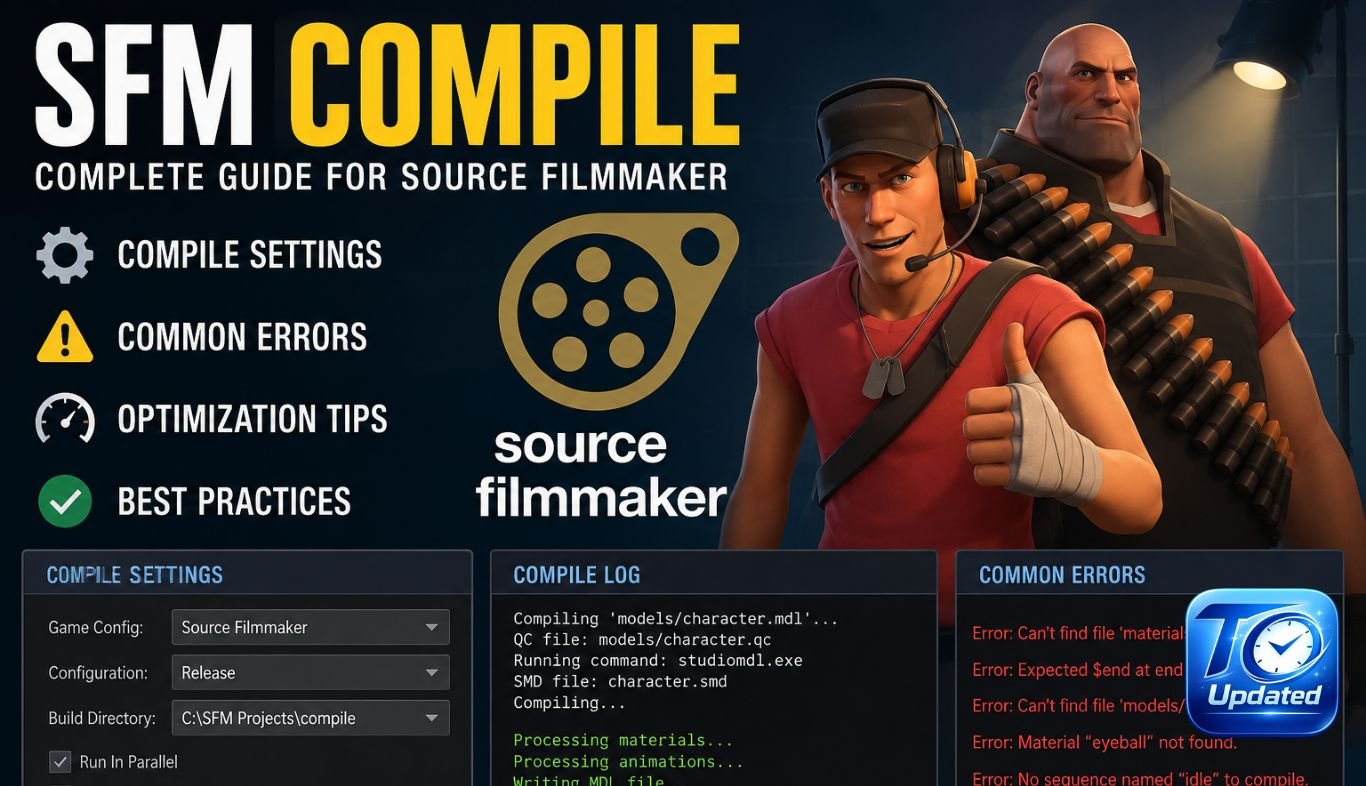
SFM Compile
If you’ve spent time creating animations in Source Filmmaker, you’ve probably come across the term sfm compile. Whether you’re building custom models, exporting maps, compiling textures, or preparing assets for animation, understanding sfm compile is one of the most valuable skills you can develop.
Many beginners confuse compiling with rendering. In reality, compiling is the process of converting editable project files into formats that the Source Engine can read efficiently. Without a successful sfm compile, models, materials, maps, and other assets may not function correctly inside Source Filmmaker (SFM).
This guide explains everything you need to know about sfm compile, including how it works, the tools involved, common errors, optimization strategies, and practical workflows used by experienced Source Engine creators. Every section is based on real Source Engine documentation, community practices, and widely accepted workflows.
What Is SFM Compile?
The phrase sfm compile generally refers to compiling assets for use in Source Filmmaker.
Depending on your project, compiling may involve:
- Converting 3D models into Source-compatible MDL files
- Building maps from VMF files
- Processing textures into VTF format
- Generating material definitions
- Preparing animations for playback
- Creating optimized game-ready assets
Instead of reading raw project files directly, Source Filmmaker relies on compiled files that load quickly and perform efficiently.
Because of this, understanding sfm compile becomes essential for anyone creating custom content.
Why SFM Compile Matters
Compiling affects nearly every aspect of an animation workflow.
Benefits include:
- Faster asset loading
- Better engine compatibility
- Smaller file sizes
- Improved rendering performance
- Fewer missing texture errors
- More stable projects
Skipping proper sfm compile steps often leads to invisible models, broken materials, missing animations, or lighting problems.
How SFM Compile Fits Into the Workflow
A typical Source Filmmaker workflow looks like this:
- Create or edit the original asset.
- Export the asset.
- Run the sfm compile process.
- Move compiled files into the correct folders.
- Test the asset inside SFM.
- Fix any errors.
- Recompile if needed.
Professional creators rarely get everything right on the first compile. Iteration is a normal part of the process.
Assets That Require SFM Compile
Several asset types require compiling before SFM can use them.
Models
Character models usually begin as FBX, SMD, or DMX files before becoming Source Engine MDL files.
Maps
Maps are designed inside Hammer Editor before being compiled into BSP files.
Materials
Textures must be converted into Valve Texture Format (VTF) files alongside material definitions (VMT).
Animations
Animation sequences often require conversion before Source Filmmaker can recognize them correctly.
Understanding the Source Engine Compilation Process
The sfm compile pipeline varies depending on the asset type, but the overall concept remains similar.
Generally, the process includes:
- Reading source files
- Validating data
- Optimizing geometry
- Processing materials
- Generating engine-compatible files
- Reporting errors
Each step helps ensure the Source Engine loads assets efficiently.
Common File Types Used During SFM Compile
You will frequently encounter these formats:
| File Type | Purpose |
|---|---|
| SMD | Source Model Data |
| DMX | Modern Source asset format |
| QC | Model compile script |
| MDL | Final compiled model |
| VTF | Texture file |
| VMT | Material definition |
| VMF | Hammer project |
| BSP | Compiled map |
| VVD | Vertex data |
| VTX | Hardware optimization data |
Learning these file types makes the sfm compile workflow much easier to understand.
Essential Tools Used for SFM Compile
Several official and community tools help creators compile Source assets.
Crowbar
Crowbar is one of the most popular utilities for compiling and decompiling Source models.
It allows users to:
- Compile QC scripts
- Verify compile logs
- Generate MDL files
- Manage model folders
Many creators consider Crowbar an essential companion for sfm compile projects.
Hammer Editor
Hammer Editor compiles maps created for Source Engine games.
It runs multiple compile stages, including:
- Geometry processing
- Visibility calculations
- Lighting generation
These stages produce playable BSP maps compatible with Source Filmmaker.
VTFCmd
Textures must often be converted into Valve Texture Format before SFM recognizes them.
VTFCmd automates this process and supports batch conversion.
Source SDK
The Source SDK contains official compile utilities used across Source Engine development.
Depending on the game version, it includes tools for:
- Models
- Maps
- Lighting
- Materials
- Physics data
Understanding these tools improves overall sfm compile efficiency.
Step-by-Step SFM Compile Workflow
Although every project differs slightly, the workflow usually follows these steps.
Prepare Source Files
Organize:
- Models
- Textures
- Materials
- Animation files
Clean organization reduces compile errors later.
Create Required Scripts
Many assets require QC scripts defining:
- Model name
- Material paths
- Hitboxes
- Animations
- Collision models
Incorrect scripts are one of the leading causes of failed sfm compile attempts.
Launch Compile Tool
Choose the appropriate compiler depending on your asset type.
Monitor the console carefully during compilation.
Review Logs
Compile logs identify:
- Missing textures
- Incorrect paths
- Syntax errors
- Missing bones
- Invalid references
Ignoring warnings often creates bigger issues later.
Test Inside SFM
Load the compiled asset into Source Filmmaker.
Check:
- Materials
- Lighting
- Animations
- Shadows
- Physics
- Scale
Testing is just as important as compiling.
Most Common SFM Compile Errors
Even experienced creators encounter compile issues.
Here are the most common ones.
Missing Texture Errors
Usually caused by:
- Incorrect material paths
- Missing VTF files
- Missing VMT files
- Folder naming mistakes
Double-check directory structure before recompiling.
QC Script Problems
A single typo inside a QC script can stop the entire sfm compile process.
Typical mistakes include:
- Incorrect quotation marks
- Invalid commands
- Missing file references
- Broken animation paths
Bone Hierarchy Issues
Character models require proper skeleton structures.
Compile failures often occur because:
- Bones were renamed
- Parent relationships changed
- Missing root bones
Keeping consistent rigging prevents these issues.
Invalid Model References
Sometimes compile logs mention missing meshes or invalid geometry.
Common causes include:
- Deleted objects
- Incorrect export settings
- Corrupted SMD files
Re-exporting from your 3D software usually fixes the problem.
Optimizing the SFM Compile Process
A successful sfm compile is not only about producing files that work. It is also about creating assets that perform efficiently inside Source Filmmaker. Large projects containing detailed environments, multiple characters, and high-resolution textures can quickly become difficult to manage if assets are not optimized before compiling.
Below are proven techniques used by experienced Source Engine creators.
Reduce Unnecessary Geometry
High-polygon models look impressive, but they also increase memory usage and slow project performance.
Before running an sfm compile, review your model and remove:
- Hidden internal faces
- Duplicate vertices
- Unused objects
- Tiny details that will never be visible
Cleaner geometry often produces smaller compiled files and faster loading times.
Optimize Texture Resolution
Textures have a significant impact on performance.
Choose resolutions that match the intended viewing distance.
For example:
- 512×512 for small props
- 1024×1024 for most objects
- 2048×2048 only when close-up detail is necessary
Using unnecessarily large textures increases memory consumption without improving visual quality.
Organize Project Folders
Keeping assets organized simplifies every sfm compile.
A common folder structure includes:
models/
materials/
maps/
particles/
sound/
scripts/
Consistent organization also makes troubleshooting much easier.
Best Practices Before Running SFM Compile
Following a checklist before compiling helps avoid common mistakes.
Verify File Paths
Broken paths remain one of the most common reasons for compile failures.
Ensure every referenced file exists and matches the exact folder and filename. Remember that some Source Engine tools treat filenames as case-sensitive.
Keep Naming Consistent
Use simple file names.
Good examples include:
- robot_body.smd
- warehouse_wall.vtf
- city_map.vmf
Avoid spaces and unnecessary special characters.
Back Up Your Source Files
Compiled files cannot replace your original project files.
Always keep backups of:
- QC scripts
- Source models
- Texture images
- Animation files
- Hammer projects
This makes it much easier to recover if an sfm compile introduces unexpected issues.
Understanding QC Scripts
A QC (QuakeC) script controls how models are compiled for the Source Engine. Every successful sfm compile involving models depends on a properly written QC file.
A QC script typically defines:
- Model name
- Material directory
- Skeleton information
- Animation sequences
- Collision model
- Surface properties
- Body groups
Even small mistakes inside a QC script can prevent a model from compiling.
Common QC Commands
Some frequently used commands include:
$modelname$body$cdmaterials$sequence$collisionmodel$surfaceprop$scale
Understanding what each command does makes troubleshooting much easier.
Map Compilation in Source Filmmaker
Many creators associate sfm compile only with character models, but maps also require compilation before they can be used.
Maps created in Hammer Editor begin as VMF project files. They must be compiled into BSP files that Source Filmmaker can load.
The Three Main Compile Stages
BSP Stage
The BSP stage converts map geometry into a playable level structure.
This process creates the BSP file that stores the compiled map.
VIS Stage
The VIS process calculates visibility.
It determines which parts of the map should render from different locations, improving performance.
Large maps may require considerable time during this stage.
RAD Stage
RAD calculates lighting.
It processes:
- Static lights
- Shadows
- Light bouncing
- Ambient illumination
Proper lighting dramatically improves the final appearance of a scene.
Model Compilation Workflow
When compiling character models, the workflow generally follows these steps:
- Create the model in 3D software.
- Build the skeleton.
- Apply UV mapping.
- Export the mesh.
- Create textures.
- Write the QC script.
- Run the sfm compile.
- Test the compiled model.
- Fix any issues.
- Recompile if necessary.
Professional creators often repeat this cycle several times before publishing an asset.
Texture Compilation Explained
Textures are another essential part of the sfm compile workflow.
Unlike many modern engines that accept PNG or JPG files directly, the Source Engine primarily uses Valve Texture Format (VTF).
Alongside each VTF file is a Valve Material Type (VMT) file, which tells the engine how the texture should behave.
Material Properties
A VMT file may define properties such as:
- Diffuse texture
- Normal maps
- Specular reflections
- Transparency
- Self-illumination
- Environment mapping
Correctly configured materials improve the realism of your animations.
How Long Does SFM Compile Take?
Compilation time depends on several factors.
These include:
- Asset complexity
- Polygon count
- Texture resolution
- Lighting quality
- Computer hardware
- Storage speed
Simple props may compile in just a few seconds.
Detailed environments with advanced lighting may take several minutes.
Very large maps can require considerably longer because visibility and lighting calculations are computationally intensive.
Troubleshooting Slow Compile Times
If your sfm compile process takes longer than expected, consider these improvements.
Close Unnecessary Applications
Freeing system memory allows compile tools to use more available resources.
Store Projects on an SSD
Solid-state drives significantly reduce loading and writing times compared to traditional hard drives.
Simplify Test Builds
During development, lower lighting quality and use simplified geometry where possible.
Run a full-quality compile only when preparing the final version.
Check Compile Logs
Unexpected delays may indicate repeated warnings or errors.
Reading the log carefully often reveals issues that can be corrected before the next compile.
Common Beginner Mistakes
Many new creators encounter the same problems during their first sfm compile projects.
Avoid these mistakes:
- Forgetting required texture files
- Incorrect folder structures
- Broken QC syntax
- Exporting unsupported formats
- Renaming bones after rigging
- Ignoring compiler warnings
- Testing only after major changes instead of compiling incrementally
Building good habits early will save considerable time as projects become more complex.
Security and File Management Tips
When downloading community assets for sfm compile, always use trusted sources.
Before compiling:
- Scan downloaded files with reputable antivirus software.
- Avoid unknown executable tools.
- Keep backups of original project files.
- Document any custom compile settings for future reference.
Good file management not only protects your work but also makes collaboration with other creators much easier.
Advanced SFM Compile Techniques
Once you understand the basics of sfm compile, you can begin using more advanced workflows that improve efficiency, reduce errors, and produce higher-quality assets. Experienced Source Filmmaker creators rarely rely on default settings alone. Instead, they refine their workflow based on the type of project they are building.
Using Compile Logs Effectively
Every sfm compile generates a log file or console output. Many beginners ignore these logs, but they are one of the most valuable troubleshooting tools available.
Compile logs typically include:
- Errors that stop compilation
- Warnings about missing files
- Information about optimization
- Material loading issues
- Animation problems
- File path references
Instead of guessing what went wrong, always read the compile log from the beginning. The first reported error often causes many of the warnings that follow.
Difference Between Errors and Warnings
Understanding the distinction is important.
Errors
Errors prevent the sfm compile from finishing successfully.
Examples include:
- Missing source model
- Invalid QC syntax
- Missing animation file
- Corrupted export
Warnings
Warnings do not always stop compilation but indicate potential problems.
Examples include:
- Duplicate materials
- Unused bones
- Large texture sizes
- Minor geometry issues
Ignoring warnings repeatedly can eventually create larger problems in complex projects.
Improving Compile Speed
A slow sfm compile can interrupt your creative workflow. Fortunately, several techniques can reduce compile times.
Work With Smaller Test Assets
Instead of compiling an entire project after every change, test individual assets whenever possible.
For example:
- Compile a single model.
- Test one animation.
- Verify one material.
Once everything works correctly, perform a complete compile.
Reduce Lighting Quality During Testing
When compiling maps, high-quality lighting calculations take the most time.
Many creators use lower-quality lighting settings during development and reserve full-quality builds for the final release.
Keep Software Updated
Updated versions of community tools often include:
- Bug fixes
- Better compatibility
- Faster processing
- Improved error reporting
Using current versions helps make the sfm compile process smoother.
Working With Custom Models
Custom models are among the most popular reasons creators learn sfm compile.
The general workflow includes:
- Create the mesh.
- Rig the skeleton.
- Apply UV mapping.
- Paint textures.
- Export SMD or DMX files.
- Write the QC script.
- Compile the model.
- Test inside Source Filmmaker.
- Fix issues.
- Repeat until satisfied.
Patience is essential. Even experienced artists rarely achieve a perfect compile on the first attempt.
Common Material Problems
Materials often appear correctly in 3D software but fail after sfm compile.
Typical causes include:
Incorrect Material Paths
The material folder referenced in the QC file must exactly match the compiled directory.
Even one missing folder level can break materials.
Missing VMT Files
A VTF texture alone is not enough.
Without the corresponding VMT file, Source Filmmaker cannot determine how the material should render.
Unsupported Texture Formats
Convert textures using the appropriate Source Engine tools before compiling.
Using unsupported formats may produce missing textures or error messages.
Version Compatibility
Not every Source Engine game uses identical asset formats.
When planning an sfm compile, verify that your assets are compatible with the version of the Source Engine used by Source Filmmaker.
Differences may include:
- Model versions
- Material shaders
- Animation support
- Physics definitions
- Map features
Using assets designed for another Source Engine branch sometimes requires additional adjustments.
Performance Tips for Large Projects
Large cinematic projects can include:
- Multiple characters
- Complex environments
- Dynamic lighting
- High-resolution textures
- Particle systems
Efficient sfm compile practices help maintain stable performance.
Some useful recommendations include:
- Limit unnecessary texture resolutions.
- Remove hidden geometry.
- Reuse materials where practical.
- Organize assets into logical folders.
- Delete unused project files.
Good organization improves both compile speed and long-term project maintenance.
SFM Compile Best Practices
Following industry-standard practices makes projects easier to manage.
Plan Before You Build
Create a folder structure before importing assets.
Name Files Clearly
Avoid vague filenames such as:
- model1
- final2
- newmodel
Instead, use descriptive names like:
- soldier_head
- warehouse_floor
- police_vehicle
Compile Frequently
Small, frequent sfm compile tests are easier to troubleshoot than one massive compile at the end of development.
Save Multiple Versions
Keep several project versions rather than overwriting the same files repeatedly.
Versioned backups allow you to restore earlier work if problems appear later.
SEO-Friendly Summary of the SFM Compile Workflow
For quick reference, here is the typical sfm compile workflow:
| Stage | Purpose |
|---|---|
| Create asset | Build the original model, map, or texture |
| Export source files | Prepare SMD, DMX, or VMF files |
| Configure scripts | Create QC or material definitions |
| Run compile tools | Generate Source-compatible files |
| Review logs | Identify warnings and errors |
| Test in SFM | Verify functionality and appearance |
| Optimize | Improve performance and fix issues |
| Final compile | Produce the finished assets |
Internal Link Suggestions
Add links to related articles on your website, such as:
- How to Install Source Filmmaker
- Best Source Filmmaker Animation Tips
- How to Fix Missing Textures in SFM
- Crowbar Tool Beginner’s Guide
- Source Engine File Formats Explained
These internal links help users discover more content and improve your site’s SEO structure.
Suggested Image ALT Text
Use descriptive ALT text that naturally includes the main keyword:
- sfm compile workflow diagram
- sfm compile tools for Source Filmmaker
- sfm compile model process
- sfm compile error troubleshooting
- sfm compile optimization guide
- how to perform sfm compile successfully
Frequently Asked Questions (FAQ)
What does sfm compile mean?
SFM compile refers to converting source assets—such as models, maps, textures, or animations—into formats that the Source Engine and Source Filmmaker can use. Depending on the asset type, this may involve generating files like MDL, BSP, VTF, or VMT.
Is compiling the same as rendering in Source Filmmaker?
No. Rendering creates the final video or image from your animation, while sfm compile prepares assets so Source Filmmaker can load and use them correctly. Compiling happens before rendering and focuses on asset compatibility rather than visual output.
Which tools are commonly used for sfm compile?
Several trusted tools are widely used in the Source Engine community, including:
- Crowbar for compiling and decompiling models
- Hammer Editor for map compilation
- Source SDK compile utilities
- VTFCmd for converting textures into Valve Texture Format (VTF)
Each tool serves a different purpose within the overall workflow.
Why does my sfm compile fail?
Common reasons include:
- Missing texture files
- Incorrect file paths
- Errors in the QC script
- Missing source models
- Invalid animation references
- Unsupported file formats
Reading the compile log carefully is usually the fastest way to identify the root cause.
Can beginners learn sfm compile?
Yes. Although it has a learning curve, beginners can master sfm compile by starting with simple projects, following official documentation, and testing assets incrementally. Learning one asset type at a time—such as models or textures—makes the process much more manageable.
How can I speed up the sfm compile process?
You can improve compile times by:
- Testing smaller assets first
- Reducing map lighting quality during development
- Organizing project folders
- Using an SSD instead of a traditional hard drive
- Closing unnecessary background applications
- Optimizing models and textures before compiling
These practices help keep development efficient.
Does sfm compile affect animation quality?
Indirectly, yes. While compiling does not change your creative animation itself, a proper sfm compile ensures models, materials, animations, and maps function correctly inside Source Filmmaker. Well-compiled assets reduce visual glitches, missing textures, and playback issues.
Is sfm compile still relevant today?
Absolutely. Although Source Filmmaker is based on the older Source Engine, many creators continue to produce animations, posters, and cinematic projects with it. Anyone creating custom content still needs to understand the sfm compile process to build compatible assets.
Conclusion
Understanding sfm compile is one of the most valuable skills for anyone creating custom content in Source Filmmaker. Whether you’re working with models, textures, animations, or maps, compiling ensures that your assets are converted into formats the Source Engine can use reliably.
Throughout this guide, you’ve learned what sfm compile means, why it matters, the tools involved, the different file types you’ll encounter, and practical methods for troubleshooting common problems. You also explored optimization techniques, advanced workflows, and best practices that can help reduce errors and improve project performance.
The key to success is consistency. Organize your files carefully, validate paths before compiling, review compile logs after every build, and test your assets regularly. These habits make the workflow more efficient and help you avoid many of the issues that frustrate new creators.
Final Thoughts
Mastering sfm compile takes practice, but every successful project builds your confidence and technical understanding. Rather than trying to memorize every command or setting, focus on learning the purpose behind each step in the compilation process. Over time, troubleshooting becomes easier, compile times become shorter, and your custom assets become more polished.
As the Source Filmmaker community continues to share tutorials, tools, and workflows, staying informed and following official Source Engine documentation will help you maintain compatibility with current best practices. Whether you’re creating cinematic animations, custom characters, detailed environments, or game-ready assets, a solid understanding of sfm compile provides the foundation for professional-quality results.